
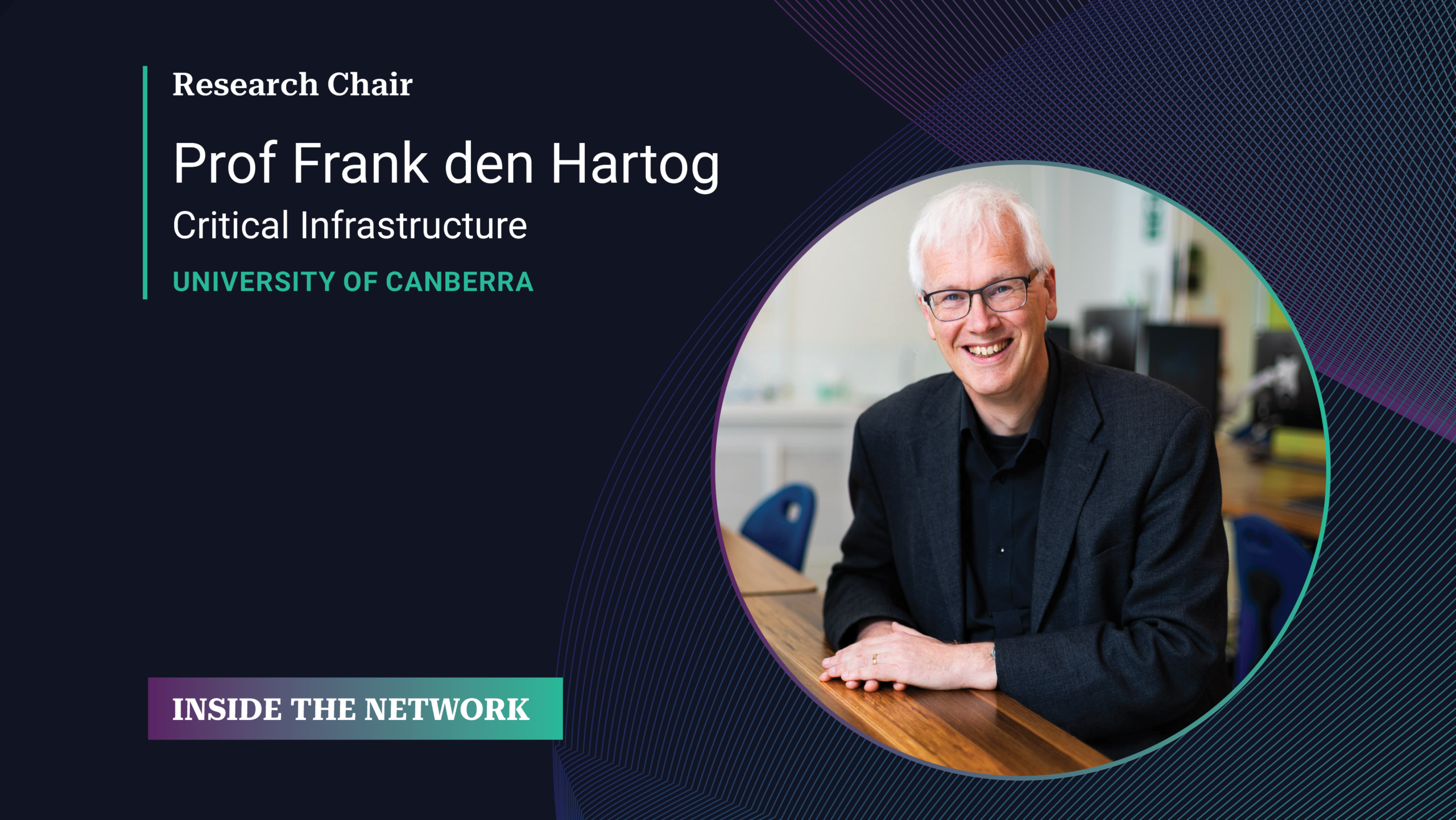
Field: Critical Infrastructure
Based at: University of Canberra
Partnered with: Cisco + Innovation Central Canberra
What inspires your work?
I want to make significant contributions to innovations for the benefit of our society. And I want to take students along with me in that journey. To them, I want to be that teacher they later remember because I made a difference, because I lived the example of walking together, driven by curiosity and genuine care for others.
What big problem or challenge are you trying to solve right now?
In the past decades, much of our critical infrastructure got privatised and dominated by complex software and related global supply chains. In many cases, this has eroded the availability of critical services to our society. Our challenge is to regain our grip on that availability, but without losing the advantages that privatisation and “softwarisation” have brought. Today, the biggest concerns lie in the fields of cyber security and resilience, the lack of underpinning sovereign capability, and the rise of disruptive technologies such as AI.
What are you excited about in 2026?
The research landscape in Australia is changing and the NIIN has a defining role in that. I am excited to see how this translates into closer involvement of our universities in applied research and innovation ecosystems with industry and government. Which leads to rapidly growing opportunities, already today. I am talking to new innovation partners almost every week now.
Why is collaboration so important in your field?
The big problems I want to tackle are wicked: they often concern systems of systems as well as legacy architectures and business interests that became engrained for decades. Unravelling those will require not just technology, but also innovation in business models, processes, policy, regulations, and behaviour. In other words, a multidisciplinary approach.
One piece of advice for emerging innovators?
Keep reading and communicating. We have too many solutions on the market looking for a problem. Some people call that research valorisation. In my view, valorisation can only be successful if a very deep and detailed understanding of the problem to be solved is obtained before the research even started.