
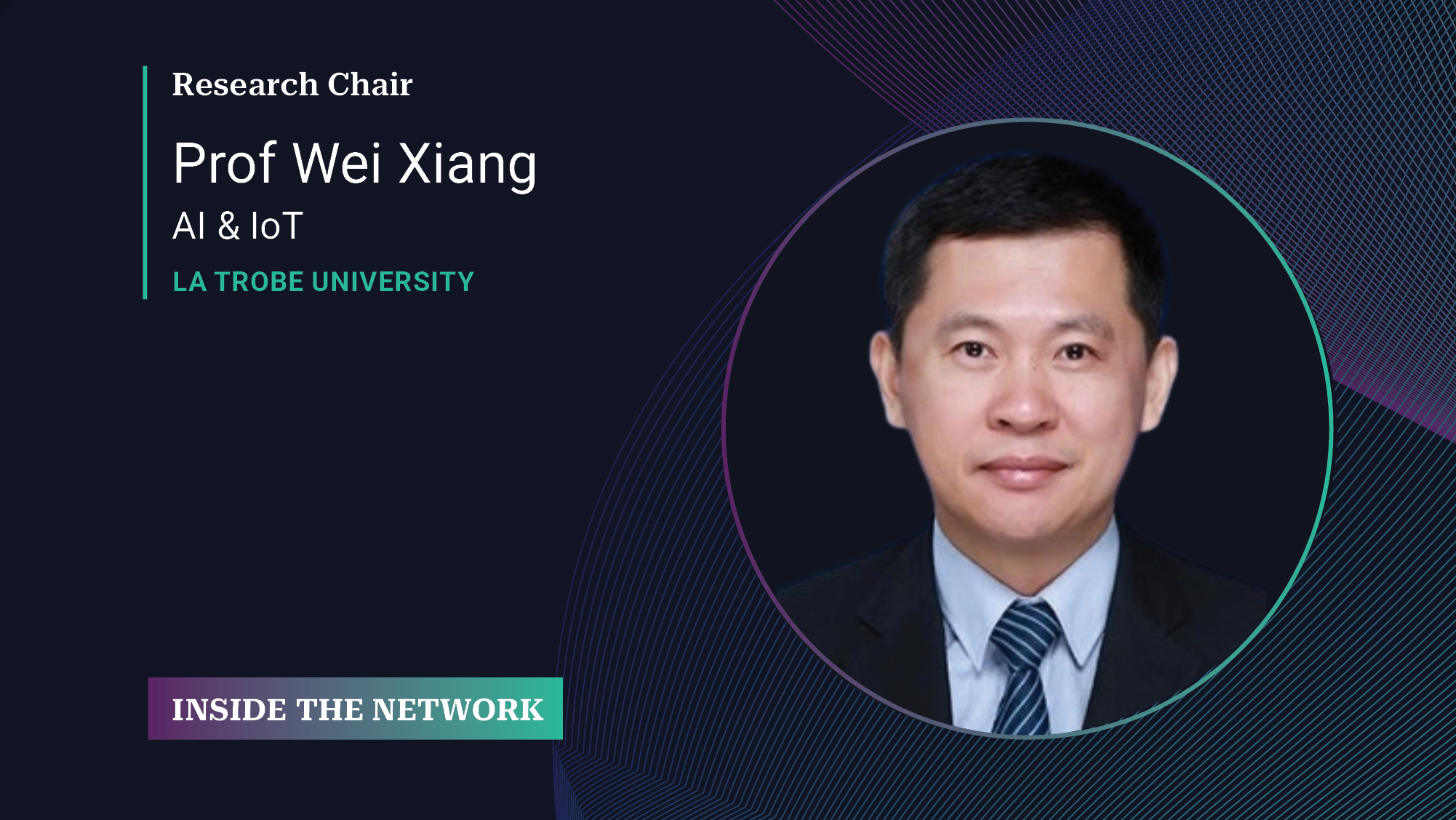
Field: Artificial Intelligence + Internet of Things
Based at: La Trobe University
Partnered with: Cisco
What inspires your work?
I am inspired by seeing research make a practical difference to people’s lives. Bringing together artificial intelligence and the Internet of Things creates opportunities to address challenges in healthcare, agriculture and environmental sustainability. Our work with Aglantis on smart irrigation, for example, shows how research can help farmers make better decisions while saving water and energy. I also find great satisfaction in helping students and emerging researchers develop the skills and confidence to take their ideas into the world.
What big problem or challenge are you trying to solve right now?
A major challenge is moving AI beyond the digital world and enabling it to interact safely, intelligently and reliably with the physical world. This requires more than better algorithms. It also requires high-performance computing, trusted data, advanced sensing and communications, robotics, domain expertise and clear pathways to real-world adoption. My current work focuses on developing this broader “physical AI” ecosystem, particularly for medical innovation, advanced manufacturing and other high-impact applications, while ensuring that the resulting technologies are responsible, energy-efficient and useful to end users.
What are you excited about in 2026?
I am especially excited about expanding the Australian Centre for AI in Medical Innovation and progressing plans for a new Physical AI Centre at La Trobe University. These initiatives will bring together AI, robotics, sensing, digital twins and advanced computing to address real-world challenges in health, manufacturing and other sectors. I am also excited by the transition from traditional data centres to “AI factories” that can support large-scale model development, simulation and deployment. Most importantly, 2026 presents an opportunity to deepen collaboration across the NIIN network and translate shared research strengths into national impact.
Why is collaboration so important in your field?
No single discipline or organisation can deliver meaningful AI innovation alone. Successful translation requires computer scientists and engineers to work alongside clinicians, researchers, industry practitioners, government, communities and end users. Collaboration helps us identify the right problems, access the necessary data and infrastructure, test solutions in realistic environments and build trust in new technologies. Networks such as NIIN are particularly valuable because they connect complementary expertise across universities and create opportunities to undertake projects at a scale that would be difficult for any one institution to achieve independently.
One piece of advice for emerging innovators?
Start with a meaningful problem rather than a fashionable technology. Spend time understanding the people affected by the problem and involve them from the beginning. Be ambitious, but remain open to evidence, feedback and failure. Innovation is rarely a straight path, and the strongest outcomes usually come from diverse teams that combine technical excellence with persistence, curiosity and a clear sense of purpose.